
To implement virtual functions, C++ uses a special form of late binding known as the virtual table. The virtual table is a lookup table of functions used to resolve function calls in a dynamic/late binding manner. The virtual table sometimes goes by other names, such as “vtable”, “virtual function table”, “virtual method table”, or “dispatch table”.
Because knowing how the virtual table works is not necessary to use virtual functions, this section can be considered optional reading.
The virtual table is actually quite simple, though it’s a little complex to describe in words. First, every class that uses virtual functions (or is derived from a class that uses virtual functions) is given it’s own virtual table. This table is simply a static array that the compiler sets up at compile time. A virtual table contains one entry for each virtual function that can be called by objects of the class. Each entry in this table is simply a function pointer that points to the most-derived function accessible by that class.
Second, the compiler also adds a hidden pointer to the base class, which we will call *__vptr. *__vptr is set (automatically) when a class instance is created so that it points to the virtual table for that class. Unlike the *this pointer, which is actually a function parameter used by the compiler to resolve self-references, *__vptr is a real pointer. Consequently, it makes each class object allocated bigger by the size of one pointer. It also means that *__vptr is inherited by derived classes, which is important.
By now, you’re probably confused as to how these things all fit together, so let’s take a look at a simple example:
class Base
{
public:
virtual void function1() {};
virtual void function2() {};
};
class D1: public Base
{
public:
virtual void function1() {};
};
class D2: public Base
{
public:
virtual void function2() {};
};
Because there are 3 classes here, the compiler will set up 3 virtual tables: one for Base, one for D1, and one for D2.
The compiler also adds a hidden pointer to the most base class that uses virtual functions. Although the compiler does this automatically, we’ll put it in the next example just to show where it’s added:
class Base
{
public:
FunctionPointer *__vptr;
virtual void function1() {};
virtual void function2() {};
};
class D1: public Base
{
public:
virtual void function1() {};
};
class D2: public Base
{
public:
virtual void function2() {};
};
When a class object is created, *__vptr is set to point to the virtual table for that class. For example, when a object of type Base is created, *__vptr is set to point to the virtual table for Base. When objects of type D1 or D2 are constructed, *__vptr is set to point to the virtual table for D1 or D2 respectively.
Now, let’s talk about how these virtual tables are filled out. Because there are only two virtual functions here, each virtual table will have two entries (one for function1(), and one for function2()). Remember that when these virtual tables are filled out, each entry is filled out with the most-derived function an object of that class type can call.
Base’s virtual table is simple. An object of type Base can only access the members of Base. Base has no access to D1 or D2 functions. Consequently, the entry for function1 points to Base::function1(), and the entry for function2 points to Base::function2().
D1′s virtual table is slightly more complex. An object of type D1 can access members of both D1 and Base. However, D1 has overridden function1(), making D1::function1() more derived than Base::function1(). Consequently, the entry for function1 points to D1::function1(). D1 hasn’t overridden function2(), so the entry for function2 will point to Base::function2().
D2′s virtual table is similar to D1, except the entry for function1 points to Base::function1(), and the entry for function2 points to D2::function2().
Here’s a picture of this graphically:
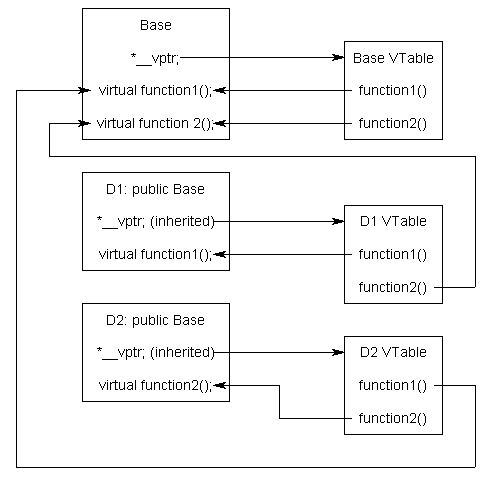
Although this diagram is kind of crazy looking, it’s really quite simple: the *__vptr in each class points to the virtual table for that class. The entries in the virtual table point to the most-derived version of the function objects of that class are allowed to call.
So consider what happens when we create an object of type D1:
int main()
{
D1 cClass;
}
Because cClass is a D1 object, cClass has it’s *__vptr set to the D1 virtual table.
Now, let’s set a base pointer to D1:
int main()
{
D1 cClass;
Base *pClass = &cClass;
}
Note that because pClass is a base pointer, it only points to the Base portion of cClass. However, also note that *__vptr is in the Base portion of the class, so pClass has access to this pointer. Finally, note that pClass->__vptr points to the D1 virtual table! Consequently, even though pClass is of type Base, it still has access to D1′s virtual table.
So what happens when we try to call pClass->function1()?
int main()
{
D1 cClass;
Base *pClass = &cClass;
pClass->function1();
}
First, the program recognizes that function1() is a virtual function. Second, uses pClass->__vptr to get to D1′s virtual table. Third, it looks up which version of function1() to call in D1′s virtual table. This has been set to D1::function1(). Therefore, pClass->function1() resolves to D1::function1()!
Now, you might be saying, “But what if Base really pointed to a Base object instead of a D1 object. Would it still call D1::function1()?”. The answer is no.
int main()
{
Base cClass;
Base *pClass = &cClass;
pClass->function1();
}
In this case, when cClass is created, __vptr points to Base’s virtual table, not D1′s virtual table. Consequently, pClass->__vptr will also be pointing to Base’s virtual table. Base’s virtual table entry for function1() points to Base::function1(). Thus, pClass->function1() resolves to Base::function1(), which is the most-derived version of function1() that a Base object should be able to call.
By using these tables, the compiler and program are able to ensure function calls resolve to the appropriate virtual function, even if you’re only using a pointer or reference to a base class!
Calling a virtual function is slower than calling a non-virtual function for a couple of reasons: First, we have to use the *__vptr to get to the appropriate virtual table. Second, we have to index the virtual table to find the correct function to call. Only then can we call the function. As a result, we have to do 3 operations to find the function to call, as opposed to 2 operations for a normal indirect function call, or one operation for a direct function call. However, with modern computers, this added time is usually fairly insignificant.
12.6 — Pure virtual functions, abstract base classes, and interface classes
|
Index
|
12.4 — Early binding and late binding
|
12.6 — Pure virtual functions, abstract base classes, and interface classes
Index
12.4 — Early binding and late binding
Simple and superb!!!!
If a base class has 1 pure virtual function then what will be the corresponding entry in the
vtable? will it be NULL?
Yes, the vtable entry will be NULL. If you think about it, a pure virtual function in a class makes it abstract which means we can never instantiate the class – which means we can’t call that function directly or indirectly from any base\derived class objects (we can’t create base class objects anyway and in case of derived class, if you define the “pure virtual function” of base class then you have provided the implementation. And if you don’t – then the derived class in turn becomes an abstract class. And so it goes on and on.
To cut it short – yes, it will have NULL. Then you might ask who is going to invoke the NULL function? Not me. No one can call it and it also wastes memory. So Microsoft came with its own invention for that, when you declare a class with __declspec(novtable) for abstract base classes – you are effectively saying – “I know what I am doing. I don’t want to declare the vtable for this abstract base class, since no one can instantiate an object of this class anyway. So please save some memory and donot construct the vtable. Thank you”.
Also consider C# – to declare a class as abstract all you have to do is:
“abstact class IAmIntuitiveAbstractClassDeclaration”
Isn’t that intuitive instead of define virtual function, and then make that virtual function “pure” – = 0? I might have as well said “you can declare an abstract base class by making one of the virutal functions a zombie and declare it like this
“virtual void laspseInDesign const = Zombie” Seems ad hoc to me.
D1 cClass;
Base *pClass = &cClass;
pClass->function1();
How pClass gets the *__VPTR pointer of D1.
Please careful experience the following words.
Because cClass is a D1 object, cClass has it’s *__vptr set to the D1 virtual table.
And then you set a base pointer to D1.
Because pClass is a base pointer, it only points to the Base portion of cClass. However, also note that *__vptr is in the Base portion of the class. so pClass has access to this pointer. Finally, note that pClass->__vptr points to the D1 virtual table!
Hi alex,
Could you please give your help to solve the above query?
Thank you very much.very nice article.
can you please post some articles on function overloading like this.
Very nice explanation on Vtable..ThankQ
but i have one basic doubt.
we created appropriate object and compiled.
Vtable and object creation(so *vptr is initialized) everything is done during compile time itself.and we clearly mentioned base pointer is pointed to derived obj.So what is the special thing that will happen during run time and why it called late binding.
Object allocation in the memory will be done at run time and assignment of that allocated memory address can be assigned only at Run time.
This will happen at the Run time and hence called ‘Late binding’.
Its a nice Explanation from the original author..
Good Job! :-)
ALEX, Thanks a lot…for helping many of us to understand ‘vtables’.
Q: can any one let me know if we can display the ‘vtable’ for a class? If yes, HOW?
ref : ‘http://en.wikipedia.org/wiki/Virtual_method_table'. Here they are displaying the vtable for a class as below :
>>>>>>>>>>>>>
G++ 3.4.6 from GCC produces the following 32 bit memory layout for the object b2:[nb 1]
b2:
+0: pointer to virtual method table of B2
+4: value of int_in_b2
virtual method table of B2:
+0: B2::f2()
<<<<<<<<<<
-thnx,
Vijay Chulaki
Great explanation. Many thanks.
Its really good and simple to understand about Virtual function and VTable. Can you please explain the second step in your explanation [Index the virtual table to find the correct function to call].
Thank you.
Well i know i can point a derived class object to a base class, but not vice versa.
But is it possible to create the derived class objects through base class object.
Well i have class Base, form which class D1, D2, and cD3 are derived.
Now using some condition, i want to create objects of D1, D2 and D3 with the object of the base.
class Base { public : void go() { cout<<"\n i am in base:"; } }; class D1 : public Base { public : void go() { cout<<"\n I am in d1:"; } }; class D2 : public Base { public : void go() { cout<<"\n i am in d2:"; } }; int main() { Base *ptr = new D2(); ((D1*)ptr)->go(); // it will call D1 ((D2*)ptr)->go(); // it will call D2 return 0; }Here you are creating object of D2 and storing it in base class pointer ptr.
Since there is no relation between D1 and D2, typecasting of ptr to D1 will lead to heap corruption.
I came across this type of issue in my code.
Thanks a Lot.
This is by far the most clear explanation of V-table i ever read.
Regards,
Satya
consider array of derived class object {d[0],d[1],d[2],d[4],d[5]};
and base class pointer points the first element of the array.
what is the output when increment the base class pointer. where it is point?
Regards
kruti
It’s beyond being helpful, indeed. :)
This makes the question: In which compilation unit the vtable of a class is placed by the compiler. For instance, if we have the case:
[classA.h] struct A { virtual void f(); virtual void g(); }; [classAf.cpp] #include "classA.h" void A::f() {} [classAg.cpp] #include "classA.h" void A::g() {}most compilers will do somewhat like this: The vtable is placed in the object file with the definition of the first non-pure, non-inline, virtual function of the class (classAf.o in this example) with external linkage.
But what if we have:
[classA.h] struct A { virtual void f() {} // virtual, but inlined }; [classB.h] #include "classA.h" struct B : public A { void f() {} }; [main.cpp] #include "classB.h" void useA1( A* ); void useA2( A* ); A* a = new B(); useA1( a ); useA2( a ); [useA1.cpp] #include "classA.h" void useA1( A* a ) { a->f(); // This should call B::f() } [useA2.cpp] #include "classA.h" void useA2( A* a ) { a->f(); // This should call B::f() }useA1() and useA2() must have access to the vtable of class A, but where is it defined, since the compiler rule from previous example does not match here?
In can be defined in both useA1.cpp and useA2.cpp, but than it must have static linkage.
Right or do I miss something?
Thanks a lot…it is crisp, simple and straight
ohhhh… its really too good. explanation thank u very much…
[...] http://www.learncpp.com/cpp-tutorial/125-the-virtual-table/ [...]
Hey really good explanation!!!Thanks a lot!!
Wonderful explaination. Can you explain diamond (virtual) inheritance as well ?
This diagram is all what’s needed to explain the whole story. Thank you very much.
Truly awesome !!!! The most simple and precise explanation .
-Student of IIT Madras
Hi Alex,
It is a very nice explanation.
I have one query: If *__vptr value is same for all instances of a class. why it can not be “static” (initialized only once per class) and why it needs to be replicated in all instances (which adds additional pointer size to all instances).
Hi
it can’t be static because it will change the address according to the allocation.
C1 *cClass= new C1();
D1 *dClass= new D1();
Base *pClass = &dClass;
Base *p1Class= &cClass;
vptr of pClass instance is pointing D1 vtable
vptr of p1Class instance is pointing C1 vtable
Heading : Non virtual function of base class is getting executed though it is overridden
in the derived class.
Please find the code sample below.
class vehicle
{
public:
virtual void speed()
{
cout << "In base speed" << "\n";
}
virtual void maintain()
{
cout << "In base maintain" << "\n";
}
void value()
{
cout << "In base value" << "\n";
}
};
class wheel4 : public vehicle
{
public:
virtual void speed()
{
cout << "In 4wheel speed" << "\n";
}
virtual void maintain()
{
cout << "In 4wheel maintain" << "\n";
}
void value()
{
cout << "In wheel4 value" <value();
}
After the execution of ptr->value(), the function present in the class “vehicle” is
getting executed. As per my understanding the “value” present in wheel4 should
be executed.
What is the reason for this?
Non virtual function can’t be overridden in derived class. only speed and manitain method is overridden in wheel4 class.
for that reason it is printing vehicle’s class value method output.
As Alex had stated in the above diagram,
When you do
vehicle* vobj = new wheel4;
here what happens is *ONLY* the *__vptr of vehicle class will get updated with the vtable of wheel4.
remember that you have only one function in the virtual table i.e, void speed()
if you want to print “In wheel4 value” make the void value() function in the vehicle class as virtual void value() by doing this you are adding this function into the virtual table..
the crux of this revolves around the *__vptr getting filled by the vtable pointer.This is how c++ obtains the dynamism which it claims.
Hope this clear the air !
First i want to give thanks for a very good explanation. But i have some queries related with it for that reason i have written a demo program. the program is as below.
#include
class D1{
public:
void b1(){cout<<"D1:b1";}
void b2(){cout<<"D1:b2";}
virtual ~D1(){cout<<"D1";}
};
class B1: public D1{
public:
virtual void b1(){cout<<"B1:b1";}
void b2(){cout<<"B1:b2";}
~B1(){cout<<"B1";}
};
class B2:public B1{
public:
void b1(){cout<<"B2:b1";}
void b3(){cout<<"B2:b3";}
~B2(){cout<<"B2";}
};
class C1: public B2{
public:
void b3(){cout<<"C1:b3";}
~C1(){cout<b1();
b->b2();
delete b;
B1 *b= new C1();
b->b1();
b->b2();
delete b;
return 0;
}
Now in this case i think every time runtime reindexing will happen on the vitual table of C1 class before pointing base class _vptr to point to the C1 class vtable so that it only access the correct method list so first reindexing then pointing. am i right?
Then my next point is after reindexing base class will be able to access the destructor of the derived class if we declare the destructor as virtual in base class. As we know the signature of the destructor is varying form base to derived class then through which mechanism it is resolving the destructor signature issue.
Hi my last portion of code is not properly pasted so i am providing it further.
class C1: public B2{
public:
void b1(){cout<<"C1:b1";}
void b2(){cout<<"C1:b2";}
void b3(){cout<<"C1:b3";}
~C1(){cout<b1();
b->b2();
b->b3();
delete b;
B1 *b1= new C1();
b1->b1();
b1->b2();
delete b1;
return 0;
}
i have another question suppose i have two functions func1 is virtual and func2 is non virtual in class B1.
now if we write
B1 *b=NULL;
b->func1();
b->func2();
and try to access the functions. we will be able to access the non virtual function but we will not be able to access the virtual.
What is the reason of it? why we are able to access the non virtual functions and why we are not able to access the virtual functions?
Thank you, thank you, thank you. Absolutely the best tutorial written for anything in human history.
Thanks! Best explanation on v-table I have come across. May be make this as wikipedia entry and replace the existing one! This is far better than that!
This is a very good explanation of vtable concept in c++.I got the concept at the first glance itself.Great work .
keep going
great man. i have not such an easy explanation of vtable
Superb Explanation by original author. I am very impressed.
Thanks for good explanation.. but i could not understand about the function calling from vptr. how is it
determine which function need to call. li
“it looks up which version of function1() to call in D1’s virtual table. This has been set to D1::function1(). Therefore, pClass->function1() resolves to D1::function1()!”
very good explanation in a simple way for the c++ beginners..
Very good explanation
Thanks for post…
Very neat explanation. The best I’ve ever come across on V-Table. Cheers Alex!
Marvellous!! I think i have got a perfect answer for my long lasting question.
The way each and every step has been explained is crystal clear. Moreover,
I have been through almost all the comments and found them interersting which faded away
my ambiguity regarding this topic.
Hello,
with your example:
class Base { public: virtual void function1() {cout << "Base::function1" << endl;}; virtual void function2() {cout << "Base::function2" << endl;}; }; class D1: public Base { public: virtual void function1() {cout << "D1::function1" << endl;}; }; class D2: public Base { public: virtual void function2() {cout << "D2::function2" << endl;}; };when doing a copy by value :
int main () { D1 cClass; Base pClass = cClass; pClass.function1(); }the displayed result is “Base::function1″ .
I thought it should be “D1::function1″ as *__vptr points to D1 virtual table.
So why it calls Base::function1 ?
Thanks
Very clear and lucid explanation..
Even the comments are good.
Thanks for sharing…
class ABC { public: void Draw() { cout<<"Inside ABC::Draw()\n"; } }; class BCD:public ABC { public: virtual void Draw() { cout<<"Inside BCD::Draw()\n"; } }; class DEF:public BCD { public: void Draw() { cout<<"Inside DEF::Draw()\n"; } }; int main() { ABC* ptr = new DEF(); ptr->Draw(); ((BCD*)ptr)->Draw(); BCD* ptr1 = new DEF(); ptr1->Draw(); ((ABC*)ptr1)->Draw(); getch(); return 0; }Above code generates following output.
Inside ABC::Draw()
Inside DEF::Draw()
Inside DEF::Draw()
Inside ABC::Draw()
Can anyone explain how vtable are created and accessed in above code?
Check this link.
http://www.parashift.com/c++-faq-lite/virtual-functions.html#faq-20.4
It give more info on vtables.
nicely explained. thanks
@toto
pClass is initialized with Base’s vtable.
Virtual Table’s are not copied.
would however invoke D1:function1 as pClass refers/points to cClass which had its *__vptr to be initialized to D1′s vtable.
Hi,
i wanted to know the order of functions how it is stored in the vtable.
ex:
class Base
{
public:
virtual void function1() {};
virtual void function2() {};
};
class D1: public Base
{
public:
virtual void function3() {};
virtual void function4() {};
};
how will the vtable for D1 look like?
is it – function1()
function2()
function3()
function4()
or
function3()
function4()
function1()
function2()
Thanks in advance